Peru’s presidential election headed to run off amid logistical chaos
Voting has been extended following problems with opening numerous polling stations.
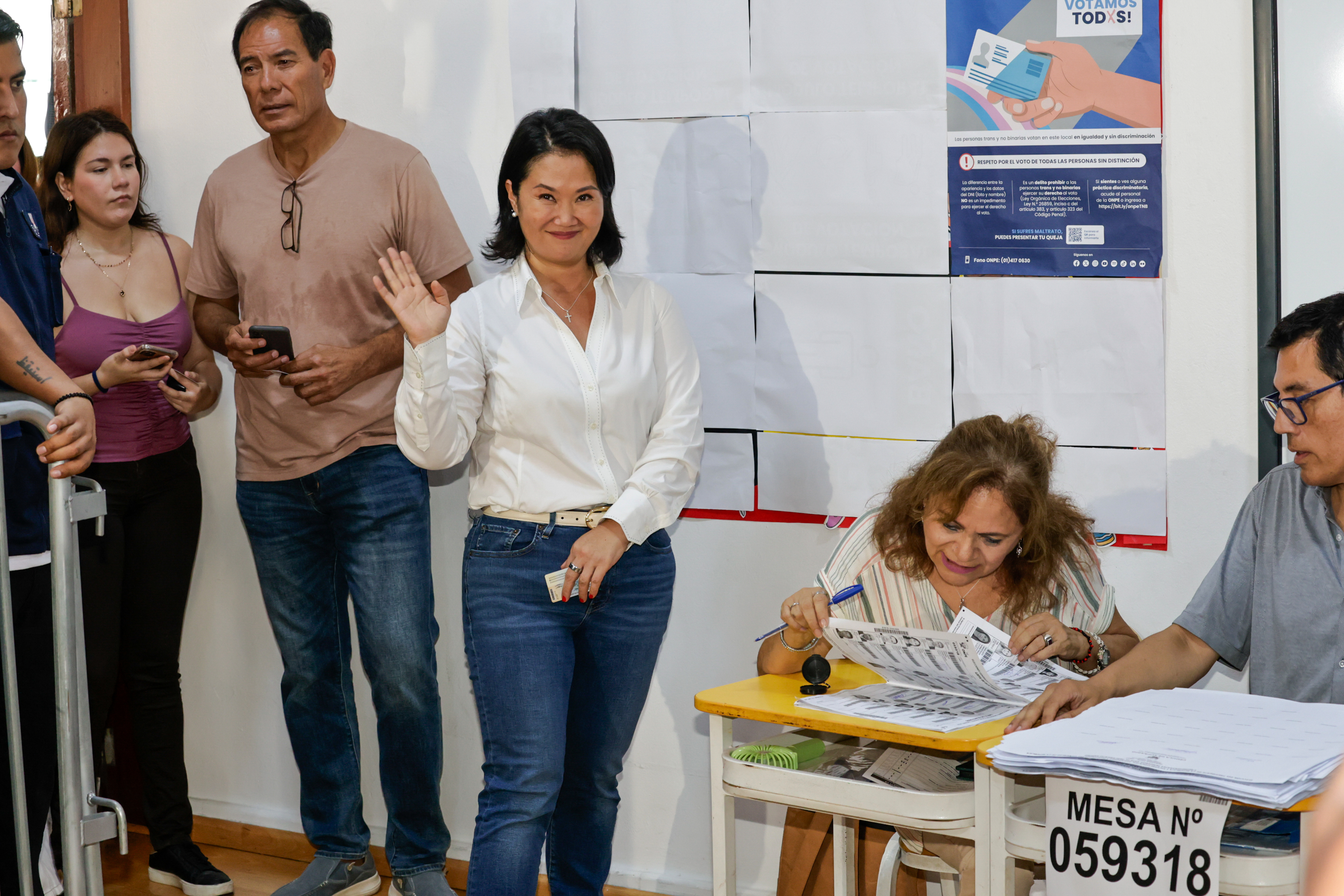

Peru’s presidential election looks set to go to a second round face-off with no candidate appearing close to securing 50 percent of the first round of voting.
Right‑wing candidate Keiko Fujimori claimed victory on Monday, tipping her to advance to the second-round. However, the election has been plagued by logistical problems and it’s unclear when voting may end.
Recommended Stories
list of 3 items- list 1 of 3Advocates push for major probe as US boat strikes in Latin America kill 157
- list 2 of 3A record-breaking field: What to expect from Peru’s presidential election
- list 3 of 3Ecuador claims 28% drop in homicides amid concerns over anti-crime campaign
Peruvians voted on Sunday for a new president and congress, with all 60 Senate and 130 lower house seats up for grabs, in elections held against the backdrop of a deep political crisis.
Exit polls and partial counts on Monday showed Fujimori, the 50-year-old daughter of disgraced former President Alberto Fujimori ahead with around 17 percent of the vote.
Far-right candidate Rafael “Porky” Lopez Aliaga was also polling strongly on around 15 percent.

Overall, there are 35 candidates on the ballot to become the country’s ninth leader in a decade, including a comedian, a media baron, a political dynasty heiress, and Aliaga, a hard‑line ex‑mayor who likens himself to a cartoon pig.
An early exit poll by Ipsos Peru had shown Fujimori leading the race with 16.6 percent, followed by left-wing candidate Roberto Sanchez with 12.1 percent, and centre-leftist Ricardo Belmont with 11.8 percent.
If no candidate clears the 50 percent threshold, the two most-voted-for candidates would advance to a second round, scheduled for June 7.
Peru’s National Office of Electoral Processes (ONPE) said on Monday it would reopen some polling stations after logistical failures prevented about 63,000 people from voting due to a lack of ballots, ballot boxes and other voting materials.
Logistical problems kept more than a dozen polling stations closed on Sunday, the ONPE said.
Amid claims of fraud, election authorities said the extension was needed to protect voters’ right to vote.
National Elections Board General Secretary Yessica Elisa Clavijo Chipoco said some polling centres would be open until 6pm local time (23:00 GMT) on Monday.
The authority did not say how many polling stations would reopen, but stated that it applied to those polling places where citizens had been unable to exercise their right to vote on Sunday.
However, later on Monday the election commission warned of further delays in reopening polling centres, the AFP news agency reported.
Thirteen polling centres were due to reopen at 7:00 am local time (12:00 GMT), but officials said that documents were still being prepared and votes had yet to be cast.
Anti-corruption police later said they had detained one election official over the problems, that prevented tens of thousands of people from voting.
Since 2018, Peru has seen eight presidents, with a high turnover rate marred by impeachments and corruption scandals, leading to voter disillusionment with weak governments.
“Peru is a mess, and there’s no candidate worth voting for,” Gloria Padilla, a fruit seller in the capital, Lima, told the Reuters news agency.
Clothing merchant Maria Fernandez, 56, shared the same sentiment.
“I wouldn’t vote for anyone. I’m so disappointed with everyone in power,” Fernandez told the AFP news agency. “We’ve been governed by nothing but corrupt, thieving scoundrels,” she added.
This is the fourth presidential bid for Fujimori, who reached the run-off in all three previous races.
While Fujimori has taken the position of guarantor of order and economic stability, her candidacy remains polarising due to her family legacy. Her father, Alberto Fujimori, was convicted of human rights abuses and corruption before he died in 2024.
On the eve of the election, Fujimori told AFP that she would “restore order” in her first 100 days if she were to win, sending members of the army to jail, deporting undocumented migrants and strengthening security at the border.
At the other end of the political spectrum, Belmont – a former mayor of Lima, running for the centre-left Civic Party Obras – was polling in second place.
Popular comedian Carlos Alvarez campaigned on a platform of being tough on crime, as Peru’s homicide rate has more than doubled in the past decade.
